Genocide and The Future of Sustainability

A ceasefire has been agreed between Hamas and the Zionist entity, brokered by the US.

Palestinians in Gaza return to their homes.

But still, the Zionist entity controls most of the Palestinian lands with no guarantee that they will stop the displacement, including the ongoing military violence in the West Bank.  

A Lancet study reported that by mid-2024, over 64,000 people—primarily women, children, and the elderly—had died from traumatic injuries in Gaza, with projections surpassing 70,000 by October. The recent report by Anadalo Agency in October 2025 said that over 17,000 students, 10,000 women, 20,000 children, 540 aid workers, and 254 journalists were reported killed. It has also been more than 77 years since the Nakba—the violent displacement and dispossession of 700,000 Palestinians from their land.
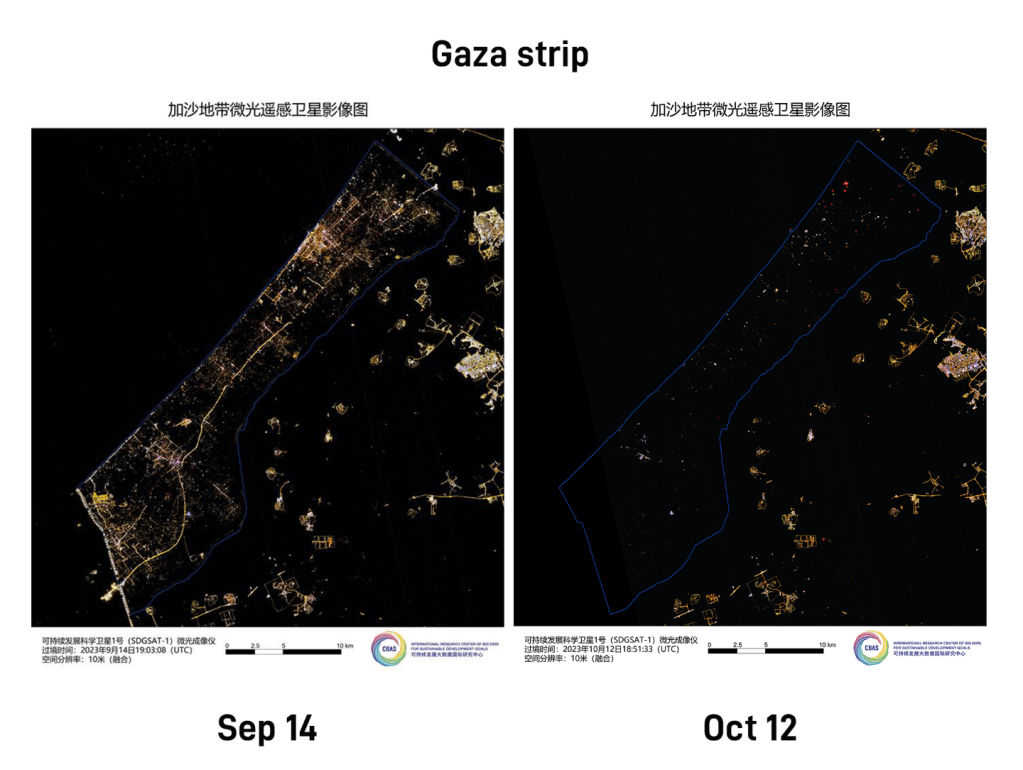
Satellite images of the Gaza Strip on September 14, 2023, and October 12. Photos: Courtesy of SDG Center. Source: Global Times.

Those are not isolated tragedies; they represent an ongoing, systematic reality of genocide. International Association of Genocide Scholars, the UN Independent International Commission of Inquiry on the Occupied Palestinian Territory, Amnesty International, and other international bodies acknowledge that act.

In that case, we need to understand that many corporations are also directly, indirectly, or knowingly complicit in the genocide.

The War Economy Behind Sustainability Report

In June 2025, the Report of the Special Rapporteur on the situation of human rights in the Palestinian territories occupied since 1967 was published by the United Nations Human Rights Council, titled “FROM ECONOMY OF OCCUPATION TO ECONOMY OF GENOCIDE.”
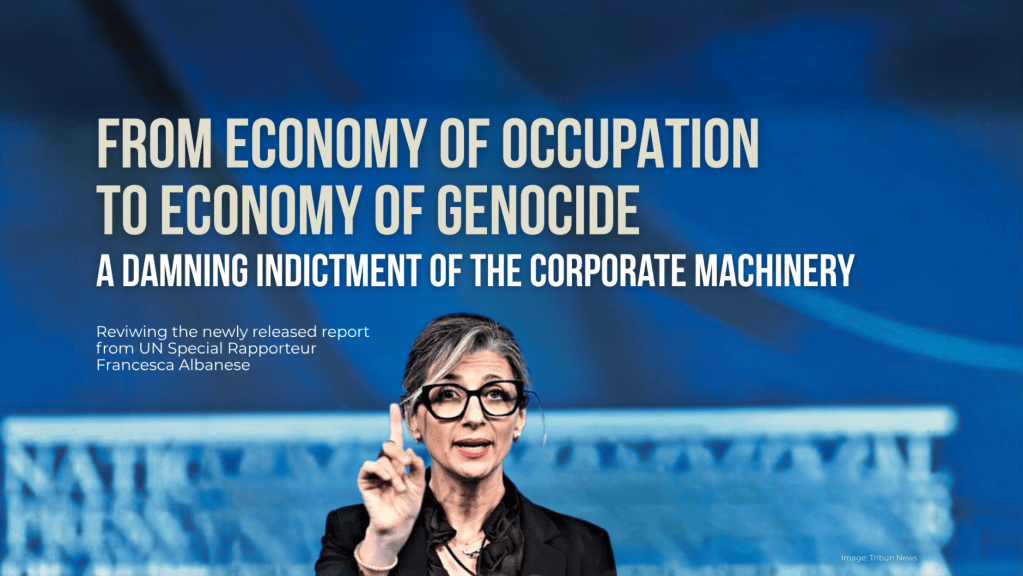
The UN Special Rapporteur’s report reveals how corporate entities, across sectors and structures, are complicit in sustaining the Zionist entity occupation and apartheid economy.

Their investigation mapped over 1,000 corporate entities potentially complicit in international crimes in occupied Palestine, spanning industries such as arms, surveillance, construction, logistics, and finance. Of these, over 45 companies were directly named for enabling and profiting from the occupation; only 15 responded to allegations. The report highlights how complex corporate structures, including parent firms, subsidiaries, franchises, and joint ventures, obscure accountability while sustaining a war economy that violates human rights and the sustainability of nature and human beings.
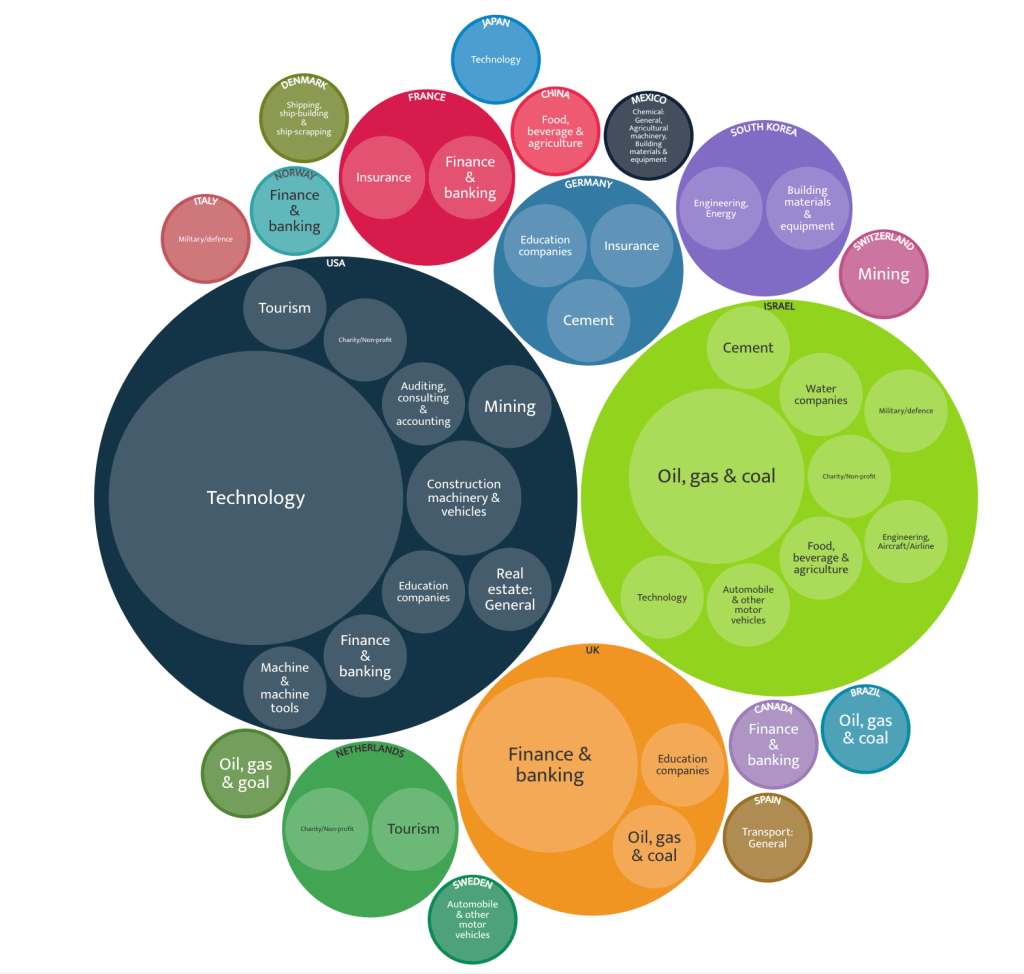
UN report highlights role of corporate actors in Israel’s occupation and unfolding genocide. Source: https://www.business-humanrights.org/

Ironically, some of them publicly champion sustainability and publish the ESG Report. That hypocrisy calls for a litmus test, not just for governments and institutions, but for corporations and, ultimately, for each of us as human beings.

Corporate Complicity in Genocide: The ESG Paradox

Palantir Technologies supplies AI targeting systems to the Israeli military and maintains a strategic partnership with its Ministry of Defense, while boasting of its ESG commitments. Maersk, a global logistics giant, has been found transporting weapons components to Israel, despite publishing human rights pledges in its ESG disclosures while denying the allegation. Google and Amazon, through Project Nimbus, provide AI and cloud services used for surveillance and military operations in Gaza. Microsoft delivers Azure infrastructure powering targeting systems responsible for thousands of civilian deaths.

“UN report lists companies complicit in Israel’s ‘genocide’: Who are they?”Source: https://www.aljazeera.com/news/2025/7/1/un-report-lists-companies-complicit-in-israels-genocide-who-are-they

These companies all release polished ESG reports, claim environmental leadership, and position themselves as ethical actors. But they fail the most fundamental test: Are you supplying the machinery of genocide? If the answer is yes, no sustainability claim can stand.

Their actions violate the Triple Bottom Line by harming people and planet, betray Stakeholder Theory by ignoring Palestinian lives, and expose a lack of supply chain traceability where ethics are conveniently omitted. This is the litmus test that cuts through public relations gloss and demands moral clarity.

Even Scholars Are Failing the Test

This litmus test applies to everyone, even scholars and climate advocates. I once engaged a professor of sustainability online on Twitter/X. He argued:

“It is very unwise if the climate movement aligns with Palestine. Climate and the Israel-Palestine issue are fundamentally different. I will publicly distance myself from them.”

I responded,

“Professor, really? War and colonialism in Palestine are environmental issues. Bombing Gaza, destroying farmland, poisoning water, these are not separate from climate justice. They are central to it. You should be ashamed, both as a scholar and a human being.”

Imperialism as the Common Root

What ties these actors together is a shared logic: dispossess for power, profit from destruction. The Zionist project continues to seize land for political and economic ends. Corporations reap wealth by supporting the machinery of war. This is not an anomaly. It is the very definition of colonialism in the 21st century, disguised under the banner of “innovation” and “green growth.”

So, Let’s Be Clear

Therefore,  if your sustainability platform is complicit in genocide, it is not sustainable.

If your ESG report ignores environmental destruction from the genocide, it is not ethical. If your climate advocacy excludes Palestine, it is not justice.

This Is A Call

To my fellow scholars in sustainability: We must decolonize our frameworks and reclaim moral clarity. To ESG professionals: Trace your supply chains, not just for carbon footprint, but for blood.

To all: Demand accountability from the genocide supply chain and continue the boycott whenever possible of those who are complicit.

Free Palestine! Free the world from imperialism and colonialism!

Student Loans: A Slippery Slope for Indonesia

This is a shorter English version of my previous post, “The student loan idea is a slippery slope; prove me wrong!” with the same substance. I sent it to the English-based media and failed to be published.

——————————————————————————————————-

The discourse surrounding student loans in Indonesia emerged intensively again after the Minister of Education, Culture, Research, and Technology issued Permendikbud Number 2 of 2024 concerning the Operational Cost Standards for Higher Education. Following this new regulation, several public universities implemented new policies that significantly increased tuition fees. At this point, this idea gained momentum due to rising undergraduate and vocational program costs.

The student loan discourse in Indonesia is a slippery slope. Once this idea becomes a policy, we must be prepared for a series of new problems it might cause. We should oppose this idea for at least three reasons. 

First, when discussing student loans, it is important to look at how this policy has been implemented in the U.S. According to Student Loan Debt Statistics, the student loan policy in the U.S. has led to a total debt of $1.6 trillion, which is used to finance higher education. This amount is equivalent to 25.572 trillion rupiahs at the current exchange rate.

Furthermore, Carlson (2020), in his publication “The U.S. Student Loan Debt Crisis: State Crime or State-Produced Harm?” mentions that student loans, initially promised and designed to accelerate social mobility by increasing higher education enrollment in the U.S. after World War II, have instead resulted in intergenerational losses. Other research showing individual, societal, and national impacts supports these intergenerational losses over the past few decades.

On an individual level, the implications of student loans are stark. Those burdened with such debts have a diminished capacity to embark on entrepreneurial ventures (American Student Assistance, 2015) or secure their first home loans (Federal Reserve, 2019). The reason is simple-they are saddled with the responsibility of repaying their education debt before they can even consider taking on new financial obligations.

Now, picture this scenario unfolding in Indonesia! Fresh graduates, with salaries barely exceeding the regional or city minimum wage, are grappling with tuition debt payments and exorbitant housing prices. The mere thought of pursuing a business idea, which inherently carries more risk than a stable job, seems like a distant dream.

At the societal and national levels, student debt negatively impacts consumption in small and medium-sized businesses (Federal Reserve Bank of Philadelphia, 2015), reduces economic growth, increases financial risk (Federal Reserve, 2018), and diminishes potential assets at retirement age (Rutledge et al., 2015).

Second, student loans negatively impact the well-being and mental health of students. It is hard to find evidence that student loans positively influence students’ well-being, mental health, and academic performance in the United States, the U.K., and several other developed countries. Academics in this field seem to agree that student debt negatively affects the well-being, mental health, and academic performance of students (Ross et al., 2004; Cooke et al., 2006; Walsemann et al., 2015; Kim & Chatterjee, 2018; Richardson et al., 2017; Pisaniello et al., 2019), especially in lower and middle-class groups (Despard et al., 2016).

Lastly, student loans could create moral hazards for the government and state university administrators. In 2010, the Constitutional Court annulled the Education Legal Entity Law, stating that the law had no binding legal force. At that time, Mahfud MD, Chief Justice of the Constitutional Court, stated, “The law tends to shift the state’s responsibility to society to bear the burden of education.”

In 2012, the government and the House of Representatives agreed to pass the Higher Education Law. Activists and civil society concerned about higher education, still feeling the spirit of education liberalization and fearing the release of state responsibility in the bill, opposed its passage. One problematic article uses the phrase “interest-free loans” in one of its articles.

Fast-forward to 2024, and this phrase has become the student loan discourse we are discussing now. The two previous arguments, the student debt crisis, and student well-being, have a series of evidence-based findings. Now, there is a solid reason to think about scenario planning, a method, and technique in strategic management for planning or anticipating what might happen.

The logic is that student loans are a market- or private-based solution when there is a disparity between students’ ability to pay and university tuition fees. The government could justify reducing operational assistance, subsidies, and higher education funding support by stating that “the private sector has also participated in student financing.”

Second, university officials could avoid the responsibility of providing tuition fee reduction assistance for vulnerable groups. Why? Because financing companies cover it. Worse, university administrators classify students into higher tuition fee groups because a fintech company has already cooperated with public universities and officially endorsed them. Does this make sense?

Both of the above are chain reactions and potential moral hazards that may occur when individuals or organizations deliberately take specific actions that are more beneficial because they do not bear the adverse consequences of their decisions.

Hypothetically asking, is it possible to have a low or even zero interest rate for student loans? It is ordered by the Higher Education Law in Paragraph 2 concerning the Fulfillment of Student Rights, Article 76, Paragraph 2(c), “an interest-free loan that must be repaid after graduating and/or obtaining a job.” However, a simulation by Elmira and Suryadarma (2018) concluded that the appropriate interest rate for all parties, namely the government, private sector, and individuals, is 10 % annually. On the other hand, the lowest interest rate in Indonesia currently is Micro People’s Business Credit at 6% per year, with an interest subsidy to national banks from the APBN of IDR 47.8 trillion in 2024.

If the government wants to implement this policy with interest subsidies for student loans, there is no need to bother. Instead of an interest subsidy, add it to the budget allocation for higher education. All the discourse on student loans from government officials deliberately goes against the law’s mandate, and it is crucial to oppose this dangerous idea. 

Disclaimer: This article is a personal opinion and does not reflect the policies of the institution where the author works.