Balai Belajar Masyarakat

Balai Belajar Masyarakat (BBM) adalah satu ruang publik yang berfungsi sebagai ruang baca, belajar, pertemuan, kelas-kelas mengasah keterampilan dan aktualisasi individu atau komunitas. Iya, perpustakaan tapi nggak sekedar perpustakaan. Coworking space tapi nggak sekedar ruang bekerja.

Sumber: ChatGPT dengan prompt tertentu.

Ruang ini bukan sekadar bangunan, melainkan platform sosial. Sebuah tempat di mana interaksi, pembelajaran, dan pertukaran ide menjadi denyut nadi yang menghidupkan ruang-ruangnya. Setiap sudutnya memiliki nilai, setiap kursi dan mejanya adalah ruang diskusi, dan setiap dindingnya menyerap lalu mengamplifikasi energi dari orang-orang yang datang dengan semangat ingin belajar dan berbagi.

Bayangkan, seorang anak kecil yang bahkan belum bisa membaca, tumbuh di ruang-ruang ini. Di sini, mereka tidak hanya menemukan buku-buku, tapi juga berproses menemukan diri mereka. Mereka bermain, belajar, dan menjelajah dunia pengetahuan di perpustakaan. Ketika mereka beranjak remaja, mereka mulai menggunakan coworking space untuk mengerjakan proyek sekolah, atau mungkin hanya untuk berdiskusi dengan teman-teman mereka tentang ide-ide baru.

Ruang ini menjadi saksi perjalanan hidup mereka. Dari anak-anak hingga dewasa, ruang ini beradaptasi dengan kebutuhan mereka, menjadi tempat untuk upskilling, reskilling, atau bahkan sekadar tempat untuk bertukar pikiran tentang isu-isu sehari-hari. Mereka yang dulunya hanya menjadi peserta, kini menjadi fasilitator, mentor, atau pemimpin diskusi, memberikan kembali apa yang telah mereka pelajari di tempat yang sama.
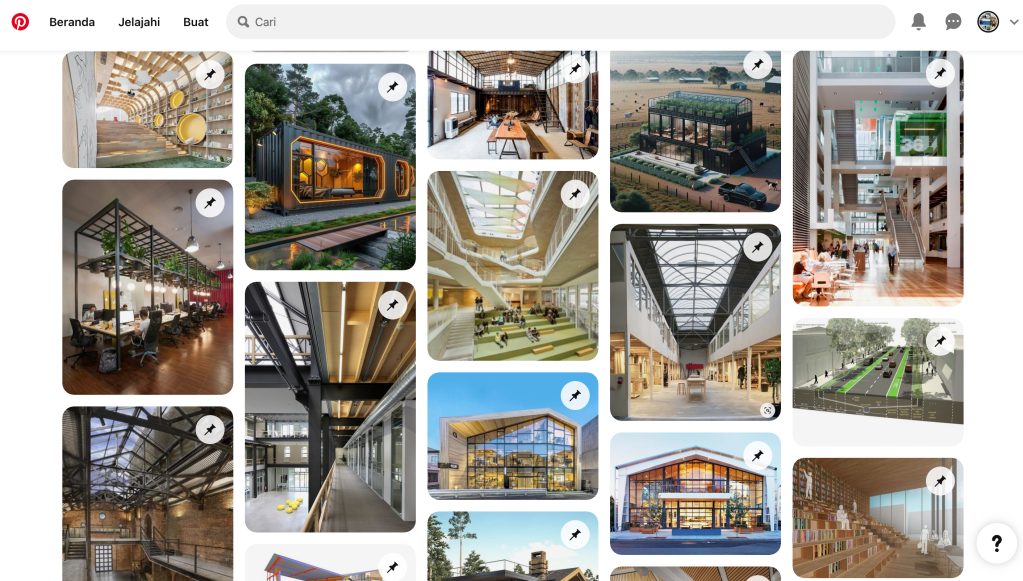
Imajinasi model coworking space atau perpustakaan besar. Sumber: Pinterest

Ruang ini adalah tempat di mana kehidupan dan pembelajaran berjalan berdampingan. Sebuah tempat di mana setiap individu, dari anak-anak hingga orang tua, bebas menemukan potensi mereka, belajar, dan berkontribusi. Inilah esensi dari Balai Belajar Masyarakat—ruang yang hidup, tumbuh, dan terus berkembang seiring dengan individu-individu yang ada di dalamnya.

Saat saya SMP-SMA, fasilitas seperti ini adalah perpustakaan daerah kabupaten yang sangat dekat dengan alun-alun atau kantor pemerintahan. Namun jika dibangun secara masif, Balai Belajar Masyarakat tidak harus terpaku pada pusat-pusat pemerintahan atau administratif. Ruang-ruang ini bisa hadir di setiap kelurahan atau berbasis distrik (kecamatan), ditempatkan di titik-titik yang relevan dengan kehidupan sehari-hari masyarakat. Fleksibilitas lokasinya adalah kunci, mengikuti gravitasi pusat penduduk, sehingga mudah dijangkau dan dekat dengan komunitas yang akan menggunakannya. Balai ini bisa ditempatkan di area yang memiliki akses transportasi umum yang baik, memudahkan mobilitas orang-orang yang datang untuk belajar, berdiskusi, atau bekerja.

Sumber: ChatGPT dengan prompt tertentu.

Selain itu, dekatnya lokasi dengan aglomerasi sekolah, pusat pendidikan, atau fasilitas umum lainnya bisa semakin memperkuat fungsinya sebagai tempat berkumpul dan belajar. Sepulang sekolah, anak-anak bisa langsung datang untuk mengerjakan tugas atau membaca, sementara mereka yang bekerja bisa memanfaatkan coworking space yang ada. Pendekatan ini memastikan bahwa Balai Belajar Masyarakat menjadi bagian integral dari ekosistem pendidikan dan komunitas setempat—bukan sekadar bangunan fisik, tapi juga bagian dari jaringan sosial dan budaya yang hidup di sekitarnya

Waktu operasional bisa menyesuaikan dengan sumber daya, kebutuhan dan kondisi sosial budaya masyarakatnya termasuk isu pembiayaan. Jika ada Balai Belajar Masyarakat yang aman dan nyaman untuk belajar selama 24 jam misalnya, para penggunanya tidak akan merasakan yang saya rasakan dulu. Saat saya ingin belajar dan mengerjakan tugas hingga larut, saya harus ke warnet (warung internet), begadang dan berkelahi tangan dengan nyamuk-nyamuk di gazebo-gazebo kampus atau harus bayar sekian puluh ribu di restoran siap saji 24 jam sambil membawa colokan tambahan bersama teman-teman senasib sepenanggungan. Menyedihkan.

Tentu, agar Belajar Masyarakat ini terus hidup dan relevan, agenda mingguan dan bulanan sudah terencana sejak setahun sebelumnya. Semua elemen masyarakat dari berbagai latar belakang umur, sosial dan ekonomi bisa berkegiatan sesuai dengan kebutuhan belajar mereka. Semacam agenda-agenda perpustakaan di negara-negara yang masyarakatnya mencintai ilmu dan menyebarluaskan pengetahuannya. Agenda-agenda ini dirancang secara kolaboratif dengan komunitas lokal, praktisi, dan akademisi, memastikan bahwa setiap kegiatan relevan dan berdampak nyata bagi masyarakat. Balai ini tidak hanya sebuah ruang, tapi juga pusat pembelajaran yang terus bergerak sepanjang tahun.

Mimpi dulu, boleh.

Semen Indonesia Group (SIG) – The Challenge of Sustainability Commitment and Strategy

This business case explores the complex sustainability challenges faced by Semen Indonesia Group (SIG), the largest cement producer in Indonesia. I analyze how SIG’s approach to sustainability has evolved over the years and the innovative strategies they are implementing to achieve their environmental goals. This includes examining the balance between sustainability commitments and maintaining operational efficiency. By reviewing SIG’s journey, hopefully, students could understand and provide insights into the broader implications for the cement industry and sustainability practices in Indonesia.

This is my second business case publication collaboration with Nikkei Business Lab. The website allows every educator to access it for free here.

PT Pos Indonesia (Persero): Forever Sleeping Giant?

This business case scrutinizes PT Pos Indonesia’s transformation journey as it aspires to become a preeminent logistics provider, inspired by the triumphs of DHL in the West. The students could examine the intricate challenges and prospects that lie ahead for this state-owned enterprise as it maneuvers through the dynamic realms of digitalization and e-commerce competition. Hopefully, students aim to illuminate the potential trajectories for PT Pos Indonesia and its future direction in the logistics sector.

This is my first business case publication collaboration with Nikkei Business Lab. The website allows every educator to access it for free here.

Student Loans: A Slippery Slope for Indonesia

This is a shorter English version of my previous post, “The student loan idea is a slippery slope; prove me wrong!” with the same substance. I sent it to the English-based media and failed to be published.

——————————————————————————————————-

The discourse surrounding student loans in Indonesia emerged intensively again after the Minister of Education, Culture, Research, and Technology issued Permendikbud Number 2 of 2024 concerning the Operational Cost Standards for Higher Education. Following this new regulation, several public universities implemented new policies that significantly increased tuition fees. At this point, this idea gained momentum due to rising undergraduate and vocational program costs.

The student loan discourse in Indonesia is a slippery slope. Once this idea becomes a policy, we must be prepared for a series of new problems it might cause. We should oppose this idea for at least three reasons. 

First, when discussing student loans, it is important to look at how this policy has been implemented in the U.S. According to Student Loan Debt Statistics, the student loan policy in the U.S. has led to a total debt of $1.6 trillion, which is used to finance higher education. This amount is equivalent to 25.572 trillion rupiahs at the current exchange rate.

Furthermore, Carlson (2020), in his publication “The U.S. Student Loan Debt Crisis: State Crime or State-Produced Harm?” mentions that student loans, initially promised and designed to accelerate social mobility by increasing higher education enrollment in the U.S. after World War II, have instead resulted in intergenerational losses. Other research showing individual, societal, and national impacts supports these intergenerational losses over the past few decades.

On an individual level, the implications of student loans are stark. Those burdened with such debts have a diminished capacity to embark on entrepreneurial ventures (American Student Assistance, 2015) or secure their first home loans (Federal Reserve, 2019). The reason is simple-they are saddled with the responsibility of repaying their education debt before they can even consider taking on new financial obligations.

Now, picture this scenario unfolding in Indonesia! Fresh graduates, with salaries barely exceeding the regional or city minimum wage, are grappling with tuition debt payments and exorbitant housing prices. The mere thought of pursuing a business idea, which inherently carries more risk than a stable job, seems like a distant dream.

At the societal and national levels, student debt negatively impacts consumption in small and medium-sized businesses (Federal Reserve Bank of Philadelphia, 2015), reduces economic growth, increases financial risk (Federal Reserve, 2018), and diminishes potential assets at retirement age (Rutledge et al., 2015).

Second, student loans negatively impact the well-being and mental health of students. It is hard to find evidence that student loans positively influence students’ well-being, mental health, and academic performance in the United States, the U.K., and several other developed countries. Academics in this field seem to agree that student debt negatively affects the well-being, mental health, and academic performance of students (Ross et al., 2004; Cooke et al., 2006; Walsemann et al., 2015; Kim & Chatterjee, 2018; Richardson et al., 2017; Pisaniello et al., 2019), especially in lower and middle-class groups (Despard et al., 2016).

Lastly, student loans could create moral hazards for the government and state university administrators. In 2010, the Constitutional Court annulled the Education Legal Entity Law, stating that the law had no binding legal force. At that time, Mahfud MD, Chief Justice of the Constitutional Court, stated, “The law tends to shift the state’s responsibility to society to bear the burden of education.”

In 2012, the government and the House of Representatives agreed to pass the Higher Education Law. Activists and civil society concerned about higher education, still feeling the spirit of education liberalization and fearing the release of state responsibility in the bill, opposed its passage. One problematic article uses the phrase “interest-free loans” in one of its articles.

Fast-forward to 2024, and this phrase has become the student loan discourse we are discussing now. The two previous arguments, the student debt crisis, and student well-being, have a series of evidence-based findings. Now, there is a solid reason to think about scenario planning, a method, and technique in strategic management for planning or anticipating what might happen.

The logic is that student loans are a market- or private-based solution when there is a disparity between students’ ability to pay and university tuition fees. The government could justify reducing operational assistance, subsidies, and higher education funding support by stating that “the private sector has also participated in student financing.”

Second, university officials could avoid the responsibility of providing tuition fee reduction assistance for vulnerable groups. Why? Because financing companies cover it. Worse, university administrators classify students into higher tuition fee groups because a fintech company has already cooperated with public universities and officially endorsed them. Does this make sense?

Both of the above are chain reactions and potential moral hazards that may occur when individuals or organizations deliberately take specific actions that are more beneficial because they do not bear the adverse consequences of their decisions.

Hypothetically asking, is it possible to have a low or even zero interest rate for student loans? It is ordered by the Higher Education Law in Paragraph 2 concerning the Fulfillment of Student Rights, Article 76, Paragraph 2(c), “an interest-free loan that must be repaid after graduating and/or obtaining a job.” However, a simulation by Elmira and Suryadarma (2018) concluded that the appropriate interest rate for all parties, namely the government, private sector, and individuals, is 10 % annually. On the other hand, the lowest interest rate in Indonesia currently is Micro People’s Business Credit at 6% per year, with an interest subsidy to national banks from the APBN of IDR 47.8 trillion in 2024.

If the government wants to implement this policy with interest subsidies for student loans, there is no need to bother. Instead of an interest subsidy, add it to the budget allocation for higher education. All the discourse on student loans from government officials deliberately goes against the law’s mandate, and it is crucial to oppose this dangerous idea. 

Disclaimer: This article is a personal opinion and does not reflect the policies of the institution where the author works.